Skip to content

6mm is equal to 0.23622 inches. It is slightly smaller than 1/4 inch. If you want to know how many inches 6mm is on a ruler, look just before the 1/4-inch mark.
You can also convert 6mm to centimeters, write it as a fraction, or use a simple formula to find its size in inches. This guide also covers other measurements, such as 14mm, 18mm, 22mm, and 25mm.
6mm Is How Many Inches?
Six millimeters equals 0.23622 inches. The answer is rounded to five decimal places.
| Measurement | Answer |
|---|---|
| 6mm in inches | 0.23622 inches |
| Rounded to 4 decimal places | 0.2362 inches |
| Rounded to 2 decimal places | 0.24 inches |
| 6mm in centimeters | 0.6 cm |
| 6mm as a fraction | About 15/64 inch |
The decimal value is useful for exact calculations. The fraction is helpful when using a ruler or measuring tape.
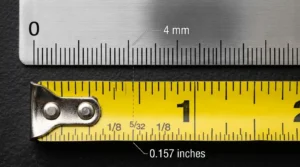
6mm Is How Many Inches on a Ruler?
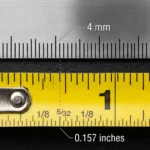
Six millimeters is a little less than 1/4 inch on an inch ruler. The 1/4-inch mark equals 6.35mm.
To find 6mm on a metric ruler:
- Find the zero mark.
- Look at the small millimeter lines.
- Count six spaces from zero.
- Stop at the sixth millimeter mark.
A metric ruler is the easiest way to measure 6mm. An inch ruler can help you estimate the size, but it may not show the exact measurement.
6mm Is How Many Inches in Fraction Form?
Six millimeters is about 15/64 inch when rounded to the nearest 64th of an inch.
Here is how the values compare:
- 6mm = 0.23622 inches.
- 15/64 inch = 0.234375 inches.
- 1/4 inch = 0.25 inches.
The fraction 15/64 inch is close to 6mm, but it is not exact. One-quarter inch is slightly larger.
Is 6mm Equal to 1/4 Inch?
No. Six millimeters is close to 1/4 inch, but the two measurements are not equal.
- 6mm = 0.23622 inches.
- 1/4 inch = 0.25 inches.
- 1/4 inch = 6.35mm.
The difference is 0.35mm. This may matter when measuring screws, tools, or parts that must fit together.

6mm to cm
Six millimeters equals 0.6 centimeters.
There are 10 millimeters in one centimeter. To convert millimeters to centimeters, divide by 10.
Formula:
Centimeters = Millimeters ÷ 10
For example:
6 ÷ 10 = 0.6 cm
This means 6mm is less than one centimeter.
How Many Inches Is 6mm Thick?
A thickness of 6mm equals about 0.2362 inches.
This measurement may describe wood, plastic, glass, metal, or another material. The conversion stays the same no matter what material you measure.
However, thickness is different from length or diameter. Always check which part of the object measures 6mm.
How Many Inches Is a 6mm Drill Bit?
A 6mm drill bit has a cutting diameter of 6mm, which equals about 0.2362 inches.
This is slightly smaller than 1/4 inch. If your project needs a hole of a certain size, check the required drill bit size before using it.
How Many Inches Is a 6mm Bracelet?
If a bracelet part measures 6mm, that measurement equals about 0.2362 inches.
The measurement may refer to the bracelet’s width, thickness, bead size, or another part. It does not usually mean the full bracelet length.
Check the product details to see exactly what the 6mm measurement describes.
Millimeters to Inches Conversion Chart
This chart helps you convert common millimeter measurements into decimal inches and approximate fractions.
| Millimeters | Decimal inches | Approximate fraction |
|---|---|---|
| 3mm | 0.1181 | 1/8 inch |
| 5mm | 0.1969 | 13/64 inch |
| 6mm | 0.2362 | 15/64 inch |
| 10mm | 0.3937 | 25/64 inch |
| 14mm | 0.5512 | 35/64 inch |
| 18mm | 0.7087 | 45/64 inch |
| 22mm | 0.8661 | 55/64 inch |
| 25mm | 0.9843 | 63/64 inch |
| 25.4mm | 1.0000 | 1 inch |
Fractions are rounded to the nearest 64th of an inch. Decimal values are more precise.

14mm to Inches Fraction
14mm equals approximately 0.5512 inches, or 35/64 inch to the nearest 64th.
Half an inch equals 12.7mm, so 14mm is a little more than half an inch.
18mm to Inches Fraction
18mm equals approximately 0.7087 inches, or 45/64 inch to the nearest 64th.
It is larger than 5/8 inch and smaller than 3/4 inch.
22mm to Inches Fraction
22mm equals approximately 0.8661 inches, or 55/64 inch to the nearest 64th.
It is slightly smaller than 7/8 inch, which equals 22.225mm.
25mm to Inches Fraction
25mm equals approximately 0.9843 inches, or 63/64 inch to the nearest 64th.
It is just under one inch because one inch equals exactly 25.4mm.
How Many Inches Is 4 × 6mm?
If you mean four measurements of 6mm added together, the total is 24mm.
24 ÷ 25.4 = 0.9449 inches.
If you mean four separate 6mm items placed side by side, their total width is 24mm only when there are no gaps or overlaps.
How Many Inches Is 5–6mm?
A measurement of 5–6mm ranges from about 0.1969 to 0.2362 inches.
- 5mm = 0.1969 inches.
- 6mm = 0.2362 inches.
The exact size depends on where the measurement falls within this range.
How Many Inches Is 3–6mm?
A measurement of 3–6mm ranges from about 0.1181 to 0.2362 inches.
- 3mm = 0.1181 inches.
- 6mm = 0.2362 inches.
This range is useful when a product or material is listed as 3–6mm thick or wide.
How to Convert Millimeters to Inches
You can convert any millimeter measurement to inches with a simple formula.
Formula:
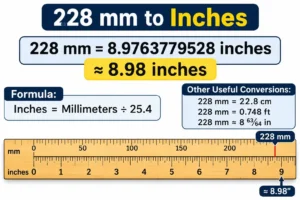
Inches = Millimeters ÷ 25.4
For example, to convert 6mm:
6 ÷ 25.4 = 0.23622 inches
To convert inches back to millimeters, multiply the inch value by 25.4.
Frequently Asked Questions
6mm equals approximately 0.23622047 inches. A useful rounded answer is 0.23622 inches.
Yes. One-eighth inch equals 3.175mm, so 6mm is larger.
6mm equals 0.6 centimeters.
No. 15/64 inch equals about 5.9531mm. It is a close fraction, but not an exact match.
14mm equals approximately 0.5512 inches, or 35/64 inch to the nearest 64th.
18mm equals approximately 0.7087 inches, or 45/64 inch to the nearest 64th.
22mm equals approximately 0.8661 inches, or 55/64 inch to the nearest 64th.
25mm equals approximately 0.9843 inches, or 63/64 inch to the nearest 64th.
Multiply the inch measurement by 25.4. For example, 1 inch equals 25.4mm.
Conclusion
6mm equals 0.23622 inches, about 15/64 inch, and 0.6 centimeters. On an inch ruler, it falls just before the 1/4-inch mark.
You can use the same conversion formula for 14mm, 18mm, 22mm, and 25mm. Divide millimeters by 25.4 to get inches. Use decimal values for greater accuracy and fractions for quick ruler comparisons.

Justin Walker writes clear how-to and explainer articles that break topics into simple steps. He aims for practical, easy-to-follow content, so readers can understand a subject quickly and know exactly what to do next.