Skip to content

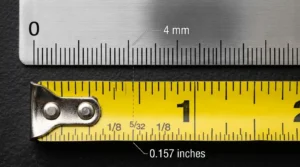
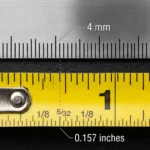
If you want to convert 4mm to inches, the answer is 0.15748 inches. As a fraction, 4mm is closest to 5/32 inch.
You can also convert 4mm to centimeters, feet, and meters. This guide explains each conversion with simple formulas, examples, and charts.
Whether you are measuring a drill bit, checking hardware, or working on a DIY project, these conversions can help you find the right size.
What Does 4mm Convert to in Inches?
4 millimeters equals 0.15748 inches.
Here is a quick look at the conversion:
| Measurement | Result |
|---|---|
| 4mm to inches | 0.15748 inches |
| 4mm to fraction | 5/32 inch (approx.) |
| 4mm to centimeters | 0.4 cm |
| 4mm to feet | 0.01312 ft |
| 4mm to meters | 0.004 m |
The decimal value gives a more exact result. The fraction is useful when you use an inch ruler or measuring tape.
4mm to Inches Fraction
4mm is closest to 5/32 inch when rounded to the nearest 1/64 inch.
Here is how it compares with nearby fractions:
| Fraction | Decimal Inches |
|---|---|
| 1/8 inch | 0.12500 |
| 5/32 inch | 0.15625 |
| 3/16 inch | 0.18750 |
The 5/32-inch measurement is very close to 4mm, but they are not exactly equal.
- 4mm = 0.15748 inches.
- 5/32 inch = 0.15625 inches.
- Difference = about 0.00123 inches.
For simple measurements, 5/32 inch is a useful estimate. For exact work, use 4mm or its decimal value.
How to Convert 4mm to Decimal Inches
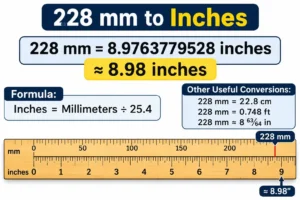
You can convert millimeters to decimal inches by dividing the millimeter value by 25.4.
Formula:
Inches = Millimeters ÷ 25.4
For 4mm:
4 ÷ 25.4 = 0.1574803
So, 4mm converted to inches equals 0.15748 inches.
This is the basic conversion for any millimeter measurement.
Convert 4mm to Inches and Feet
You can convert 4mm to inches first and then change the result into feet.
Step 1: Convert millimeters to inches.
4 ÷ 25.4 = 0.15748 inches
Step 2: Convert inches to feet.
There are 12 inches in one foot.
0.15748 ÷ 12 = 0.013123 feet
Therefore:
- 4mm = 0.15748 inches.
- 4mm = 0.013123 feet.
4mm to CM
To convert millimeters to centimeters, divide by 10.
4 ÷ 10 = 0.4
Therefore, 4mm equals 0.4 centimeters.
Remember that 10 millimeters make 1 centimeter.

MM to Inches and Feet Conversion Chart
This chart shows common millimeter measurements in inches and feet.
| Millimeters | Inches | Feet |
|---|---|---|
| 1mm | 0.03937 | 0.00328 |
| 2mm | 0.07874 | 0.00656 |
| 3mm | 0.11811 | 0.00984 |
| 4mm | 0.15748 | 0.01312 |
| 5mm | 0.19685 | 0.01640 |
| 6mm | 0.23622 | 0.01969 |
| 8mm | 0.31496 | 0.02625 |
| 10mm | 0.39370 | 0.03281 |
| 12mm | 0.47244 | 0.03937 |
| 20mm | 0.78740 | 0.06562 |
| 25mm | 0.98425 | 0.08202 |
All values are rounded for easy reading.
10mm to Inches Fraction
10mm equals approximately 0.39370 inches.
Its closest 1/64-inch fraction is 25/64 inch.
| Measurement | Value |
|---|---|
| 10mm in inches | 0.39370 |
| Closest fraction | 25/64 inch |
| 10mm in cm | 1 cm |
| 10mm in feet | 0.03281 ft |
12mm to Inches Fraction
12mm equals approximately 0.47244 inches.
Its closest 1/64-inch fraction is 15/32 inch.
| Measurement | Value |
|---|---|
| 12mm in inches | 0.47244 |
| Closest fraction | 15/32 inch |
| 12mm in cm | 1.2 cm |
| 12mm in feet | 0.03937 ft |
What Is 0.4mm to Inches?
Be careful not to confuse 0.4mm with 4mm. They are different measurements.
To convert 0.4mm to inches, divide by 25.4.
0.4 ÷ 25.4 = 0.015748
Therefore, 0.4mm equals approximately 0.01575 inches.
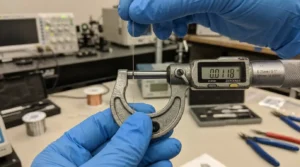
What Is a 4mm Drill Bit in Inches?
A 4mm drill bit has a diameter of 0.15748 inches.
Its closest fractional inch size is 5/32 inch.
| Drill Bit Size | Diameter in Inches |
|---|---|
| 4mm | 0.15748 |
| 5/32 inch | 0.15625 |
| 1/8 inch | 0.12500 |
| 3/16 inch | 0.18750 |
A 4mm drill bit and a 5/32-inch drill bit are close in size, but they are not identical.
If your project needs an exact hole size, use the drill bit measurement listed in the instructions.

How to Convert Other Millimeter Measurements
The same conversion formula works for other measurements.
5mm to Inches
Divide 5 by 25.4.
5 ÷ 25.4 = 0.19685
Therefore, 5mm equals 0.19685 inches.
46mm to Meters
To convert millimeters to meters, divide by 1,000.
46 ÷ 1,000 = 0.046
Therefore, 46mm equals 0.046 meters.
4 Inches to MM
To convert inches to millimeters, multiply by 25.4.
4 × 25.4 = 101.6
Therefore, 4 inches equals 101.6mm.
1/4 Inch to MM
First, change the fraction into a decimal.
1/4 = 0.25
Then multiply by 25.4.
0.25 × 25.4 = 6.35
Therefore, 1/4 inch equals 6.35mm.
These examples show how to convert measurements between millimeters, inches, and meters.
How to Convert Inches to MM Using a Calculator
An inches-to-mm calculator can help you change inch measurements into millimeters.
Follow these steps:
- Enter the inch value.
- Multiply it by 25.4.
- Read the result in millimeters.
For example:
2 × 25.4 = 50.8mm
So, 2 inches equals 50.8mm.
For millimeters to inches, divide by 25.4 instead.
How to Read 4mm on an Inch Ruler
4mm is very close to the 5/32-inch mark on an inch ruler.
These nearby ruler measurements can help you compare the sizes:
- 1/8 inch = 3.175mm.
- 5/32 inch = 3.96875mm.
- 3/16 inch = 4.7625mm.
The 5/32-inch mark is the closest to 4mm.
For more accurate work, use a ruler with small fraction marks or a metric ruler with millimeter marks.
Frequently Asked Questions
4mm converts to 0.15748 inches. Its closest 1/64-inch fraction is 5/32 inch.
4mm is approximately 5/32 inch. This is a close value, not an exact match.
4mm equals approximately 0.01312 feet.
4mm equals 0.4 centimeters.
Divide the millimeter value by 25.4. The result is the measurement in inches.
Multiply the inch value by 25.4 to get millimeters.
Yes. 4mm equals 0.15748 inches, while 1/8 inch equals 0.125 inches.
No. They are close, but 4mm equals 0.15748 inches and 5/32 inch equals 0.15625 inches.
Final Answer
4mm equals 0.15748 inches, or approximately 5/32 inch. It also equals 0.4 centimeters and 0.01312 feet.
For a quick conversion, use this formula:
Inches = Millimeters ÷ 25.4
This formula works for 4mm and other millimeter measurements. It can help you compare metric and imperial sizes when measuring tools, hardware, and other items.

Justin Walker writes clear how-to and explainer articles that break topics into simple steps. He aims for practical, easy-to-follow content, so readers can understand a subject quickly and know exactly what to do next.